
By KEVIN BERGER, Local Journalism Initiative
Niigaan Sinclair’s presentation on Indigenous education at the Prairie Spirit Teachers’ Association (PSTA) general assembly on Thursday, August 27 began on an unusual footing: an anecdote of how he came to direct a production of the famous Jewish musical Fiddler on the Roof in the early 2000s.
Speaking via videoconference at Warman High School, the University of Manitoba professor and Anishinaabe activist related how he started out as a teacher at Kelvin Heights School, which is based in the heavily Jewish neighbourhood of River Heights in Winnipeg, Man.
His task was not easy: not only does Fiddler on the Roof incorporate a large cast, but it is very much steeped in Jewish history and traditions. Growing up in Selkirk, Manitoba, he wasn’t exactly immersed in Jewish culture, so he had to do a crash course that involved speaking with a rabbi and watching the Hollywood version of Fiddler on the Roof a few times.
Needless to say, he was quickly being corrected by his students about what he was getting wrong. Fortunately, the community became more involved in the production, and Sinclair came to relate to the story of Jewish persecution as told by one grandfather.
“I realized that it wasn’t just their story – it was also my story. I understood what it’s like to be persecuted by the government, I understood what it’s like to experience ethnic cleansing and genocide, I understood what it’s like to totally remake your life from scratch,” he said.
Eventually the play went ahead, and while Sinclair won’t claim it was the greatest production ever, he did get a review from the rabbi he initially consulted.
“He looked at me right in the face and he goes, ‘Not bad.’ And then he just walks out the door,” he said.
Sinclair relayed that anecdote to demonstrate how teachers can engage with the subject of Indigenous education – basically, it doesn’t require a grand commitment or becoming an expert on the subject.
“All anyone is asking you to do is become part of the community which you already are; learn that culture, tradition, history and then contribute your own story; and then most of all, create relationships. Realize that we’re all in this together. Realize that we’re all home now; this is our territory … We are treaty people.”
He said Indigenous education is ultimately about trying to ensure that every single person feels seen, recognized and welcomed. The Canadian education system hasn’t always done that; Sinclair suggested that for the last 150 years, the people heard from the least are Indigenous peoples, which are covered in the first few pages of a Canadian history textbook before moving on to the ‘important’ story of European colonization.
And the end result? “We have created unemployable, conflictual, problematic people in a society that is equally unbalanced, unfair, very expensive … and it’s creating a big problem for all of us,” he said.
Sinclair’s presentation went on to touch on Indigenization – the concept of bringing Indigenous ways of thinking into education – while acknowledging that this is very difficult in the current education system.
He pointed out that Indigenous people tend to be thought of as storytellers, but they were scientists, botanists, mathematicians, astronomers and so on before any of that, because to survive in the world they lived in, they needed to understand it.
By only teaching about Indigenous education in a siloed way through curriculum, never touching on perceptions or culture, “we are actually beating ourselves before we even begin,” he said.
Sinclair capped off his presentation relating to how he would accompany his father Murray, the late Canadian Senator and chair of the Truth and Reconciliation Commission, to court as a child.
One day, he told his father he wanted to become a lawyer, and his father informed him that was ‘the stupidest idea ever.’
“He said, ‘You will never find justice for Indigenous peoples in the Canadian justice system,’” Sinclair said, noting that his father then encouraged him to become a teacher.
He told the crowd of assembled teachers because they were invested in an idea that every kid who shows up, regardless of their background, will be part of a community together and we all have to figure out a way to share space.
“If we’re really lucky, if we want to create a country that will withstand any challenges or threats … from climate change or an economy that’s very stressful, the only way we’re going to be doing this is through love,” he said. “That’s the way we share our space the best.”
PSTA Assembly
Prior to Sinclair’s presentation, the PSTA assembly kicked off with a reading of a land acknowledgement created by the staff, students and parents at Warman High School, which will eventually be displayed on a plaque in the commons area.
Vice principal Carmen Lebiszczak, who read the acknowledgement, noted that they were on land governed by Treaty 6, “a living agreement founded on a relationship of mutual respect, peace and shared responsibility. It is an enduring promise that continues to shape our relationships today.
“As Treaty people, the WHS community commits to acknowledging history, standing for truth, fostering respectful relationships and creating opportunities where every voice is valued, so we can continue to walk towards a better future,” she said.
Director of Education Tracey Young also gave what was her fourth presentation at a PSTA general assembly, with her presentation focusing on four things she had learned from Prairie Spirit teachers: that hope is a professional practice, relationships are the most powerful intervention teachers have, small moments often matter more than grand gestures and you never fully know the impact you have.
She concluded her address saying she wished the teachers present leave that day with more a new strategy or two to put in their educators’ toolbox.
“I hope you start this school year reminded of who you are, why you chose this work and what your presence does in the lives of your students,” she said.
“Because after years of having the privilege watching you do this work, I can tell you this with certainty: what you do matters, and who you are matters even more.”
Prairie Spirit School Division board chair Kate Kading also gave an address at the meeting, pointing out there were teachers present who had impacted hundreds of children and citing an example from her own childhood of another teacher that left a lasting impact on her.
“Her intention was to teach curriculum,” Kading said. “But her impact was teaching me consistency that I didn’t have at home, and kindness, and patience.”
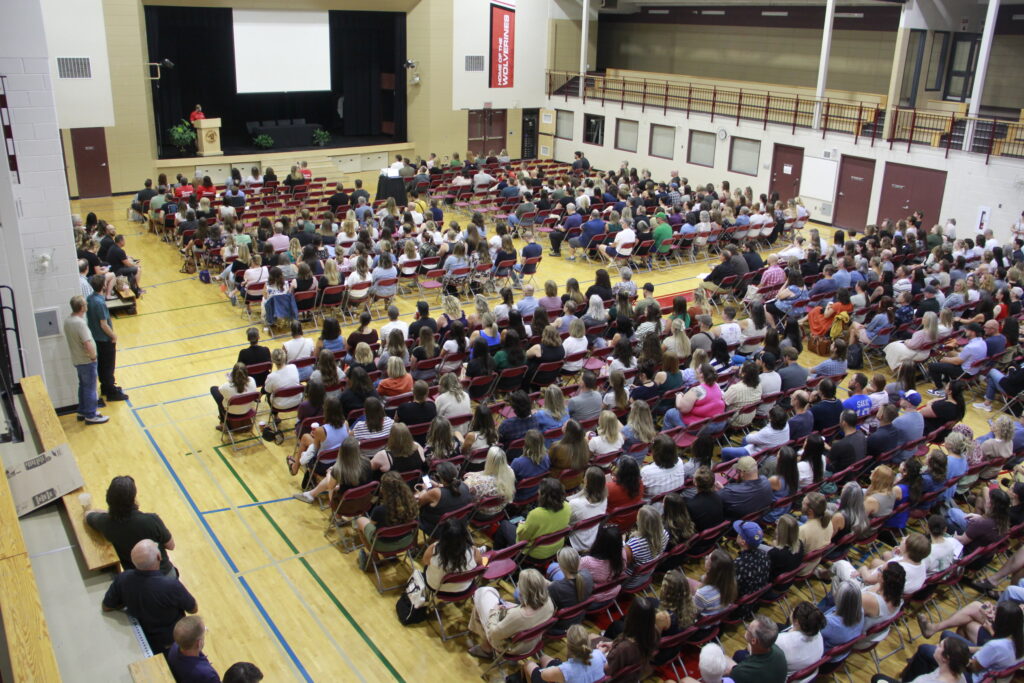
Dozens of educators crowded into the gymnasium at Warman High School for the annual Prairie Spirit Teachers’ Association (PSTA) assembly on Thursday, August 27. This photo was taken during opening presentations, which included an address by University of Manitoba professor and Anishinaabe activist Niigaan Sinclair on the subject of Indigenous education.